
The One Piece Card Game (OPTCG) entered Q2 2026 in the middle of one of the most explosive price cycles in its short history. Between April 1 and May 24, 2026, the top five One Piece TCG cards by percentage gain posted moves ranging from +65% to an intra-day spike of +400%, with the market's single hottest card, Nami (SP) EB03-053, surging +277% and topping out at a $1,300 raw NM price point. PSA grading submissions for One Piece cards hit a record high in April 2026, and TCGPlayer reported record-level transaction volumes across the Extra Booster: Heroines Edition (EB03) and Adventure on Kami's Island (OP15) sets.
This report covers every one of the five biggest One Piece TCG price movers of Q2 2026, drawing on data from TCGPlayer sold listings, eBay completed sales, PriceCharting, Sports Card Investor, GuardianTCG, MagicalMeta, and Limitless OPTCG tournament data. For each card you will find a full breakdown of price catalysts, grading premiums, competitive relevance, and an actionable investor outlook. All prices reflect the best available evidence as of May 24, 2026. Values are subject to rapid volatility; nothing in this report constitutes financial advice.
The broader OPTCG market registered 154,091 units sold across 759 tracked singles and 68,190 transactions in the seven days ending May 24, 2026 (Source: MagicalMeta), confirming that the market remains highly liquid even as individual card prices normalise from their late-2025 and early-2026 peaks. Overall market sentiment sat at a balanced 50% bullish / 50% bearish, meaning price appreciation is increasingly concentrated in a narrow tier of premium collectibles rather than spread evenly across the full card catalogue.
One Piece TCG Q2 2026 Market Context
The One Piece Card Game market in Q2 2026 was shaped by several simultaneous forces that created unusually concentrated price appreciation at the premium collectible tier. Understanding these macro drivers is essential context for evaluating each individual card's move.
New Set Releases Driving Volume
Two major product releases bookended the Q2 period. Extra Booster: One Piece Heroines Edition (EB03) launched in February 2026 and arrived in Q2 with its secondary market still repricing as collectors digested the true scarcity of SP pull rates. Adventure on Kami's Island (OP15/EB04) launched on April 3, 2026, immediately becoming one of the most actively traded One Piece sets on TCGPlayer. Both sets generated record transaction volumes according to TCGPlayer's own reporting.
April 1, 2026 Ban List Rotation
Bandai's April 1, 2026 ban list update was the single most market-moving regulatory event of Q2. Three changes were made: Charlotte Pudding (OP06-047) was banned, while OP07-045 Jinbe and Kingdom Come were removed from the banned list. The Jinbe unban produced the highest single-event percentage spike of the entire quarter, with an intra-day +400% move on announcement day. Cards entering or leaving restriction lists remain the fastest-acting price catalyst in competitive TCG markets.
OP15 Meta Dominance: Purple Enel
Adventure on Kami's Island introduced Purple Enel as the standout meta deck, described by TCGPlayer's Peter Day as "the big bad of the One Piece Card Game." Enel decks win by accelerating to 6 DON!! and repeatedly dropping OP15-118 Enel and OP15-060 Enel turn after turn. Enel was represented 86 times as the Leader in tournament decklists tracked by Limitless, and the deck produced multiple Top 8 finishes at the Treasure Cup Toronto in May 2026. This meta dominance directly drove the price of the Manga Rare variant of Enel to levels rarely seen for a competitively played card of this rarity type.
PSA Grading Record Month
PSA publicly noted that April 2026 was a record month for One Piece card submissions. This grading surge creates a two-sided effect on prices: it compresses near-term supply of raw NM copies (as they enter the grading pipeline) while simultaneously increasing the population of graded copies available at a premium over raw. The grading premium across the top five OPTCG movers ranged from +58% to +139%, giving investors a clear incentive to source raw copies at current prices ahead of slabbed resale.
OP-16: The Time of Battle Pre-Announcement Effect
Bandai's pre-announcement of OP-16: The Time of Battle, scheduled to release on June 12, 2026, generated speculative buying of cards expected to benefit from new synergies. Specifically, Ivankov ST-12 and Porche saw buying interest from investors positioning ahead of the Impel Down Leader archetype anticipated in OP-16. The OP-16 release is the key forward-looking catalyst for all competitively relevant OPTCG cards discussed in this report.
Q2 2026 One Piece TCG Top 5 Movers at a Glance
| Rank | Card | Set | Rarity | Q2 % Change |
|---|---|---|---|---|
| #1 | Nami (SP) EB03-053 | Heroines Edition | SP / SR Parallel | +277% |
| #2 | Boa Hancock (SP) EB03-026 | Heroines Edition | SP / SR Parallel | +259% |
| #3 | Enel (Manga) OP15-118 | Adventure on Kami's Island | SEC Manga Alt Art | +55% to +124% |
| #4 | Roronoa Zoro (SP) PRB02-006 | The Azure Sea's Seven | SP Alt Art | +43% to +65% |
| #5 | Jinbe (English SR) OP07-045 | 500 Years in the Future | Super Rare | +400% (intra-day) |
Source: TCGPlayer sold listings, eBay completed sales, PriceCharting, Sports Card Investor, GuardianTCG. Period: April 1 to May 24, 2026. Note on Jinbe: the +400% figure was an intra-day event on announcement day; settled price is approximately $2.50.
#1 — Nami (SP) EB03-053: Extra Booster Heroines Edition
Rarity: SP (Special Parallel / SR Parallel Foil) | Color: Yellow | Type: Character | Confidence Level: High

| Metric | Value |
|---|---|
| Q2 Start Price (Apr 1) | ~$345 (raw NM) |
| Q2 Peak Price (May 14) | ~$1,300 (raw NM) |
| Dollar Change | +$955 |
| Percentage Change | +277% |
| PSA 10 Price (May 2026) | ~$1,785 |
| 30-Day Change (from SCI) | +142% / +$491 |
| Grading Premium (PSA 10 over raw NM) | +78% to +113% |
Nami (SP) EB03-053 is the single hottest One Piece card of Q2 2026. From a starting price of approximately $345 at the open of the quarter, the card exploded to a confirmed peak of $1,300 raw NM on May 14, 2026, a gain of +$955 or +277% in just over six weeks. PSA 10 copies topped $1,785 in the same week. The 30-day rate of change tracked by Sports Card Investor was +142% (+$491), confirming the move was sustained rather than a single-day outlier. You can check recent eBay sold prices for Nami EB03-053 or shop Nami EB03-053 on eBay.
Why Nami SP Moved
- Playability: TCGPlayer analyst Anthony Tachella observed that "just about every Yellow deck in the game can find a way to squeeze four copies of our favourite navigator into their 50-card list." Nami SP sees active 4-of competitive play, meaning tournament demand for this card is constant, not speculative. The card's on-play effect interacts with Yellow's Life-card mechanics and gives strategic access to the opponent's Life pile, making it a staple rather than a tech choice.
- Set scarcity: Extra Booster EB03 featured a significantly smaller card pool than a standard booster set. This compressed the number of SP slots available per case, making each individual SP pull harder to open than in a full booster set. The structural pull-rate difficulty was not fully reflected in launch prices, and Q2 saw the market reprice toward true scarcity.
- Cross-fandom collector hype: Nami is consistently the highest-demand female character across all OPTCG collectibles, with a fanbase that extends well beyond the card game into anime, manga, and mainstream pop culture. Non-TCG collectors entering the market for character-specific cards represent a buyer pool that does not shrink when the metagame shifts.
- Grading premium incentive: PSA 10 copies trade at a roughly 38-78% premium over raw NM depending on the timing of sale, creating a compelling case for purchasing raw copies and submitting them for grading. At prices above $800, the return on a PSA 10 outcome is meaningful even after grading fees and shipping.
Investor Outlook
Medium-term bullish. Nami SP's supply is structurally capped since Extra Booster EB03 boxes are a finite product, and there is no announced reprint as of May 24, 2026. The card has already partially corrected from its $1,300 peak, with a last sale of approximately $836 as of May 18. The $800 to $1,000 raw NM range is likely the new equilibrium. Watch for a sharper correction if Bandai announces an EB03 reprint or if Yellow decks lose prominence in the OP-16 meta. The recommended action from the source report is to accumulate below $800 raw with a 6-12 month holding horizon. The grading pipeline adds a secondary return vector if PSA 10 copies can be submitted successfully.
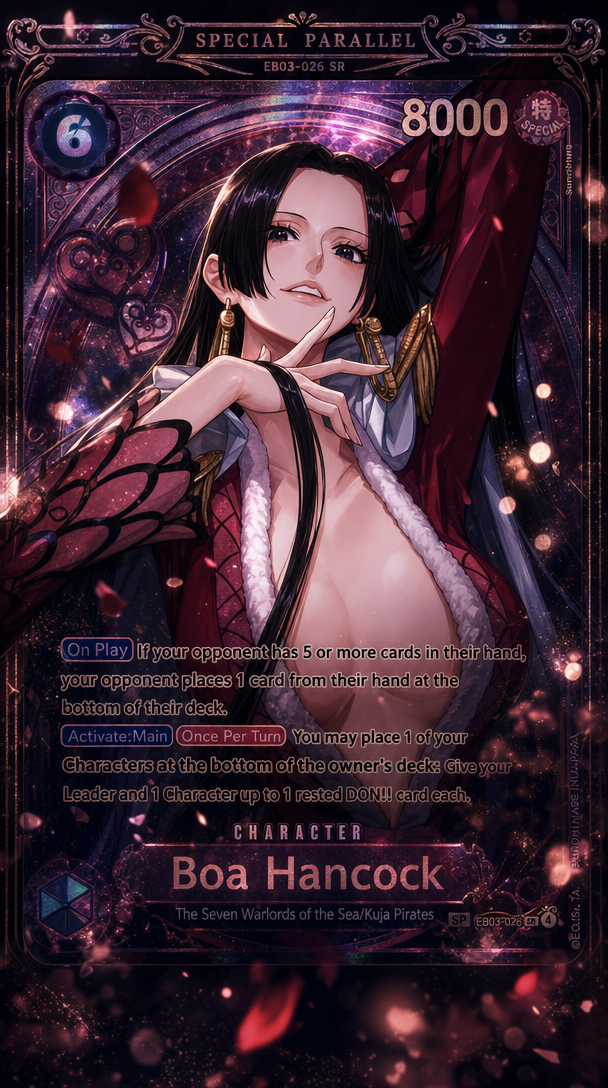
#2 — Boa Hancock (SP) EB03-026: Extra Booster Heroines Edition
Rarity: SP (Special Parallel / SR Parallel Foil) | Color: Blue | Type: Character | Confidence Level: High
| Metric | Value |
|---|---|
| Q2 Start Price (Apr 1) | ~$644 (raw NM) |
| Q2 Peak Price | ~$2,310 (raw NM, market price) |
| Dollar Change | +$1,666 |
| Percentage Change | +259% |
| 30-Day Change (from SCI) | +74.5% / +$480 |
| PSA 10 Price (May 2026) | ~$1,780 |
| Grading Premium (PSA 10 over raw NM) | +58% |
Boa Hancock (SP) EB03-026 posted the largest absolute dollar gain of any One Piece card in Q2 2026, rising by +$1,666 from approximately $644 at the start of the quarter to a market peak of $2,310. In percentage terms, the move clocked +259%, making it the second-largest percentage gainer among the top five. The Magical Meta dashboard identified this card as the #1 high-value gainer of the week at its peak, with a recorded +205.2% single-week increase. See recent eBay sold prices for Boa Hancock EB03-026 or browse Boa Hancock EB03-026 listings on eBay.
Why Boa Hancock SP Moved
- Collector pedigree: TCGPlayer writer Peter Day confirmed that "any high-rarity card featuring Boa Hancock has a spot reserved for it among the most-desirable One Piece cards in a given set." Boa Hancock has been the crown jewel of OPTCG collecting since the game's inception. Her character commands a non-TCG fanbase across anime, manga, and general pop culture that generates demand entirely independent of competitive play or metagame shifts.
- EB03 pull rate scarcity: As with Nami SP, the real Q2 price action in Boa Hancock was driven by the market fully digesting the true pull rate difficulty of SP cards within Extra Booster EB03. With a smaller overall print run than a standard booster set, SP slots in EB03 are structurally scarcer than most OPTCG SP variants from mainline sets.
- Multiple premium variant competition: The EB03-026 SP competes with, and has arguably surpassed, both the OP12-014 SP and the OP07 Manga Rare variants. Collectors racing to complete the "Hancock SP collection" across all printings drove cross-variant buying. This phenomenon creates demand that feeds multiple cards simultaneously rather than concentrating in a single version.
- Western-market scarcity gap: The EB03-026 SP is currently among the rarest printings of Hancock available in western-market card stock, which concentrates secondary market demand at this specific version when collectors cannot source it easily.
Price Discovery and the PSA 10 Anomaly
One notable data point from the Boa Hancock SP is that its PSA 10 price of approximately $1,780 remains slightly below the raw market peak of $2,310. This is an unusual relationship. In most premium TCG collectibles, graded PSA 10 copies trade at a premium above raw NM. The fact that PSA 10 copies are below the raw market peak suggests ongoing price discovery rather than a stable equilibrium, and implies that graded demand may yet catch up as the PSA 10 population grows through the current record grading cycle.
Investor Outlook
Bullish long-term, volatile short-term. The current market shows a spread between the $2,310 market price and approximately $1,125 last sold NM, reflecting bid/ask uncertainty rather than a genuine floor. Existing holders should maintain positions. New buyers willing to enter in the $1,000 to $1,100 raw range have a high-confidence 12-plus month thesis built on Hancock's structurally durable character demand. The PSA 10 grading play also remains open given the current anomaly between graded and raw prices.
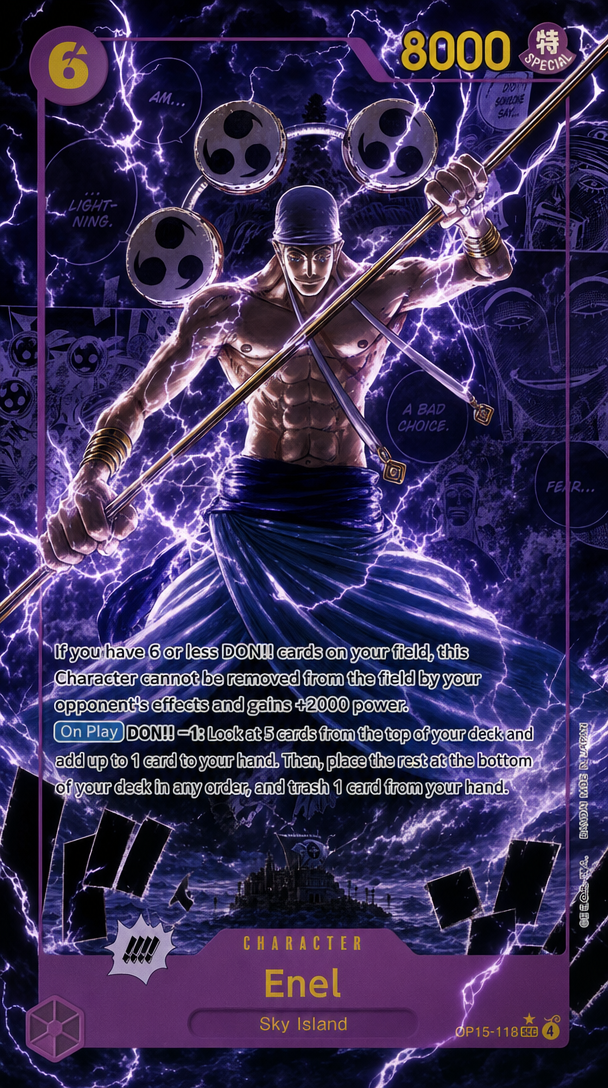
#3 — Enel (Manga) OP15-118: Adventure on Kami's Island
Rarity: Secret Rare (SEC) / Manga Alternate Art | Color: Purple | Type: Character | Confidence Level: High
| Metric | Value |
|---|---|
| Q2 Start Price (Apr 3, set release) | ~$580 (launch week raw NM) |
| Q2 Sustained Range | $900 to $1,300 |
| Q2 Dollar Range Change | +$320 to +$720 |
| Percentage Change | +55% to +124% |
| PSA 10 Price (May 2026) | ~$1,860 to $2,675 |
| TCGPlayer Market Price | ~$1,119 |
| Grading Premium (PSA 10 over raw NM) | +87% to +139% |
Enel (Manga) OP15-118 is the defining chase card of Adventure on Kami's Island (OP15). From its launch week price of approximately $580 on April 3, 2026, the card established a sustained trading range of $900 to $1,300, representing a gain of +55% to +124% off its open. PSA 10 copies reached between $1,860 and $2,675, putting the grading premium at an extraordinary +87% to +139% above raw NM, the highest grading multiplier of any One Piece card in this Q2 report. Check recent eBay sold prices for Enel OP15-118 or shop Enel OP15-118 on eBay.
Why Enel Manga Moved
- Meta catalyst: "Purple Enel has become the big bad of the One Piece Card Game," wrote TCGPlayer's Peter Day. Enel decks operate by accelerating to 6 DON!! and repeatedly playing OP15-118 and OP15-060 Enel back-to-back. This specific card is not just a meta staple, it is the core combo piece of the dominant deck. Competitive players actively seek the Manga Rare variant for tournament use despite its four-figure price tag.
- Tournament validation: Enel was represented 86 times as the Leader in tournament decklists tracked by Limitless OPTCG during Q2. Multiple Top 8 finishes at the Treasure Cup Toronto in May 2026 served as public proof points that directly drove secondary market demand after the event.
- Dual scarcity: Manga Rare is the rarest card type in OPTCG. In almost all other cases, Manga Rares are purely collector pieces with no competitive role. OP15-118 Enel is extremely unusual in that it combines the highest rarity designation with active tournament-level playability. This creates a demand overlap between competitive players and premium collectors that does not exist for most high-rarity cards.
- PSA grading premium: PSA 10 copies trading at up to $2,675 represent almost 2.4 times the raw NM price, signalling that graded demand is deep and well-established for this card.
Investor Outlook
Strong hold, with a specific meta-dependent trigger to monitor. Enel's value is supported by two pillars, competitive playability and SEC Manga rarity, but the competitive pillar is directly tied to whether the Purple Enel archetype survives the OP-16 meta rotation on June 12, 2026. If Enel remains tier-1 after OP-16, the card holds or gains. If the deck is countered or a new dominant archetype emerges, competitive demand collapses and only the collector floor remains. The TCGPlayer market price of $1,119 should be treated as the holding target. The source report's recommendation is to hold pending the OP-16 meta outcome, with a 2-4 month review horizon.
#4 — Roronoa Zoro (SP) PRB02-006: The Azure Sea's Seven ("Bubble Zoro")
Rarity: Special Parallel (SP) Alt Art | Color: Green | Type: Character | Confidence Level: High

| Metric | Value |
|---|---|
| Q2 Start Price (Apr 1) | ~$550 (raw NM) |
| Q2 Sustained Range | $630 to $1,400 |
| Q2 Peak Price | ~$1,400 (early May outlier) |
| Dollar Change (sustained) | +$235 to +$360 |
| Percentage Change | +43% to +65% |
| PSA 10 Price (May 2026) | ~$1,627 |
| TCGPlayer Market Price | ~$824 |
| Grading Premium (PSA 10 over raw NM) | +97% to +104% |
Known in the collector community as "Bubble Zoro" due to its distinctive artwork, Roronoa Zoro (SP) PRB02-006 from The Azure Sea's Seven was the fourth-largest percentage mover in OPTCG during Q2 2026. Unlike the EB03 cards which saw event-driven spikes, Zoro SP's price movement reflects sustained structural collector demand rather than a single catalytic event. This distinction makes it one of the most reliable long-term holdings in the current OPTCG market. See recent eBay sold prices for Roronoa Zoro PRB02-006 or shop Roronoa Zoro PRB02-006 on eBay.
Why Zoro SP Moved
- Structural pull difficulty: PRB02-006 was the second hardest SP to pull from The Azure Sea's Seven set, behind only the OP05 Gear Five Luffy Manga. This supply constraint is permanent and non-reprinted, creating a capped supply of raw NM copies that tightens further as cards enter grading pipelines.
- Sustained daily sales volume: Unlike event-driven movers, Zoro SP maintained more than one sold listing per day throughout Q2 2026. PriceCharting tracked 30-plus raw eBay sales, 30 PSA 10 sales, and 14 BGS 10 Black Label sales during the period. This depth of graded sales activity signals serious long-term investment positioning, not speculative day-trading.
- Cultural staying power: Roronoa Zoro is consistently one of the most popular One Piece characters globally. His baseline demand does not depend on any specific meta, set release cycle, or competitive result. Even if One Piece TCG were to rotate format or reduce in competitive popularity, Zoro character cards retain a collector floor that most other cards do not.
- PSA grading record for April 2026: PSA publicly noted that Zoro SP was among the most submitted cards during April 2026, confirming that investors are actively building graded positions. The +97% to +104% grading premium makes PSA 10 submission a compelling strategy at raw prices in the $700 to $825 range.
- Price volatility note: The wide range from $630 to $1,400 in Q2 reflects significant bid/ask spread volatility. The TCGPlayer market price of $824 is the most reliable central estimate of true value, as it filters out outlier high asks and single-auction overpays.
Investor Outlook
Long-term bullish, moderate risk. Zoro SP's floor is well-established in the $700 to $800 raw NM range, with graded upside to $1,627 for a PSA 10. The source report describes this as one of the safest OPTCG holdings due to Zoro's enduring character demand. The recommendation is to hold existing positions and accumulate on dips below $700 raw, with a 12-plus month time horizon. The wide Q2 price range should not be mistaken for weakness; it reflects the bid/ask discovery process in a relatively thin market for a high-priced card.
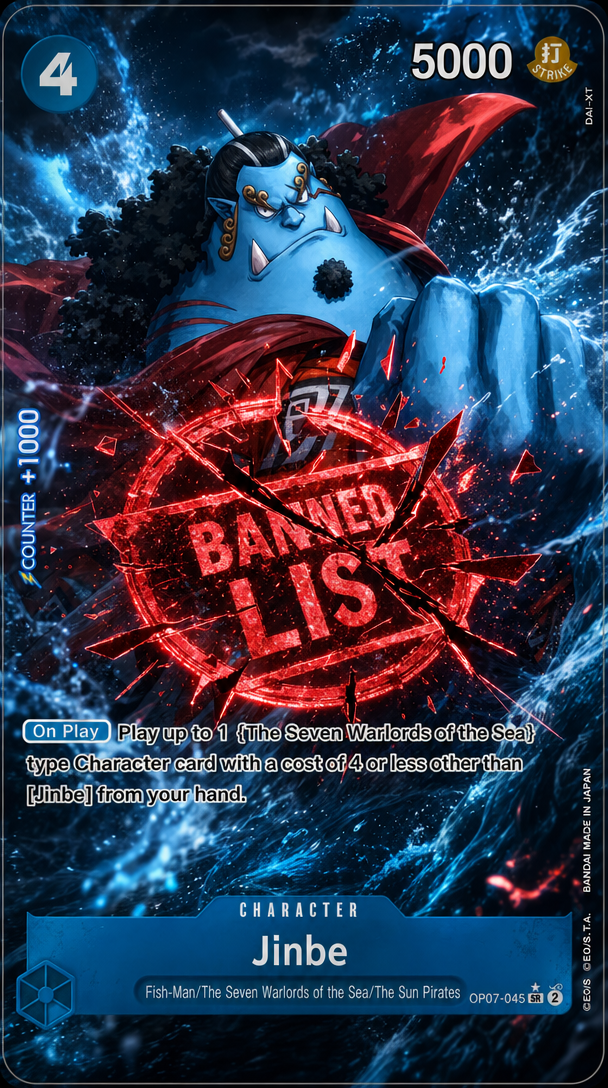
#5 — Jinbe (English SR) OP07-045: 500 Years in the Future, The Ban List Shock
Rarity: Super Rare (SR) | Color: Blue | Type: Character | Confidence Level: High
| Metric | Value |
|---|---|
| Pre-Ban Announcement Price | ~$0.50 (raw NM, English) |
| Intra-Day Peak (Announcement Day) | ~$2.50 to $5.00 |
| Q2 Settled Price | ~$2.50 (raw NM) |
| Dollar Change | +$2.00 |
| Percentage Change | +400% (intra-day peak) |
| TCGPlayer Context | "Sharp price increase of over 400%" (confirmed by Anthony Tachella) |
Jinbe (English SR) OP07-045 from 500 Years in the Future is the most instructive card in this entire Q2 report, not because of its absolute dollar value, but because of what it demonstrates about ban list event-driven trading in competitive TCG markets. The card recorded the highest single-event percentage spike of Q2 2026 at +400% intra-day, driven entirely by a rules announcement rather than competitive performance or collector demand. You can check recent eBay sold prices for Jinbe OP07-045 or shop Jinbe OP07-045 on eBay.
The Ban List Event: How It Happened
In March 2026, Bandai announced the April 1, 2026 ban list update. The changes included removing Jinbe from the banned list. The card had been restricted due to its synergy with the Blue Doflamingo Leader deck, but with Doflamingo rotating out of the format, Jinbe's restriction was simultaneously lifted. TCGPlayer analyst Anthony Tachella confirmed: "This card saw a sharp price increase of over 400% when the announcement was made." The card moved from approximately $0.50 to $2.50 to $5.00 intra-day before settling back to around $2.50 raw NM by end of Q2.
Structural Recovery Factor
Jinbe's ban list removal is not merely a short-term speculative event. The Blue Jinbe Leader card was printed in The Azure Sea's Seven (OP14), giving Jinbe SR newfound competitive synergy with a currently in-format archetype. This means the card has actual playability backing the post-ban price rather than just speculative buying pressure.
Japanese and Parallel Variants
The source report specifically tracks the English SR, which was most directly affected by the ban list event. The Japanese parallel and alt-art versions, trading in the $7 to $40 range, experienced proportional spikes. Investors who follow Japanese market prices for competitive staples can use the English SR's settlement price as a leading indicator for the premium Japanese versions.
The Investor Lesson from Jinbe
Jinbe's Q2 story is primarily a case study in pre-announcement positioning. Ban list events in OPTCG are among the most tradeable catalysts in the entire TCG investing landscape. The window between rumour or leaked information and official confirmation can yield significant percentage returns even on low-absolute-price cards. Investors who actively monitor upcoming Bandai ban list announcements, tournament bans, and format rotation discussions can position ahead of the market with asymmetric risk/reward profiles. The low pre-event price of $0.50 meant that even a small position delivered a meaningful percentage return.
Investor Outlook
Speculative hold, not a long-term position. Jinbe will see competitive play via the new Jinbe Leader archetype, but the settled price of $2.50 does not have meaningful further upside without another catalyst event. The primary recommendation from the source report is to sell into strength if the price spikes again, rather than building a structural long-term position. Watch for reprint announcements before making any larger commitments. The more valuable takeaway from this card for investors is the ban list trading strategy itself, rather than the Jinbe position specifically.
One Piece TCG Grading Premium Analysis: Q2 2026
April 2026 was a record month for One Piece card PSA grading submissions, according to PSA's public social channels. This surge directly affects secondary market pricing in two ways: raw supply is temporarily compressed as cards enter grading queues, while the growing population of slabbed copies creates a more transparent and liquid market for graded sales. The data below, sourced from PriceCharting and Sports Card Investor as of May 2026, shows the grading premium for each of the five top OPTCG movers.
| Card | Raw NM (May 2026) | PSA 10 (May 2026) | Grading Premium |
|---|---|---|---|
| Nami SP EB03-053 | ~$836 to $1,000 | ~$1,785 | +78% to +113% |
| Boa Hancock SP EB03-026 | ~$1,125 | ~$1,780 | +58% |
| Enel Manga OP15-118 | ~$993 to $1,119 | ~$1,860 to $2,675 | +87% to +139% |
| Roronoa Zoro SP PRB02-006 | ~$797 to $825 | ~$1,627 | +97% to +104% |
| Jinbe SR OP07-045 | ~$2.50 | N/A (no grading activity noted) | N/A |
Key Grading Insights
- Enel Manga OP15-118 has the highest grading multiplier of the four high-value cards, with PSA 10 copies reaching up to 2.4 times the raw NM price. This reflects both the card's competitive demand and the rarity of obtaining a pristine grade on a freshly opened Manga Rare, which tends to arrive in packs with surface-level print issues at a higher rate than standard rarity cards.
- Zoro SP is at parity, meaning PSA 10 doubles raw value. The +97% to +104% premium makes the grading math straightforward: a $800 raw copy, if graded PSA 10, returns approximately $1,627. After grading fees and submission costs of approximately $50 to $100, the upside case still produces a meaningful gain, though population growth will eventually compress the premium over time.
- Boa Hancock SP shows the lowest current grading premium at +58%, which is structurally unusual given the character's collector status. This represents either an opportunity for the graded price to catch up with raw market pricing, or alternatively a signal that the raw market price of $2,310 is overstated relative to true liquidation value. Investors should weigh both interpretations before committing capital to grading this specific card.
- BGS Black Label activity: Zoro SP saw 14 BGS 10 Black Label sales tracked by PriceCharting in Q2, indicating that a portion of the grading community views this card as worthy of BGS submission specifically. BGS Black Label copies of premium OPTCG cards command a further premium above PSA 10 at this market maturity level.
Grading Risk Reminder
PSA 10 prices assume the submitted card achieves a grade of 10. Most cards submitted for grading do not achieve a PSA 10. OPTCG cards from booster packs frequently arrive with surface scratches, print defects, or centering issues that preclude a perfect grade. Grading fees, shipping, insurance, and waiting periods represent additional costs and locked capital. These risks must be factored into any grading-based investment thesis.
Investment Themes Driving the One Piece TCG Market in Q2 2026
Across the five One Piece TCG price movers of Q2 2026, three dominant investment themes emerge. Each theme carries a different risk profile and time horizon, and each has implications beyond the specific cards discussed in this report.
Theme 1: IP Crossover Demand
The single most powerful structural driver of premium OPTCG card prices is IP crossover demand. Cards featuring Nami, Boa Hancock, and Roronoa Zoro command prices that far exceed what competitive TCG demand alone would support. These characters are coveted by anime fans, manga collectors, cosplay communities, and mainstream pop-culture investors who have never played a single game of One Piece TCG in their lives. This "crossover premium" insulates collector-tier cards from metagame corrections.
Even if Nami SP is banned, if Yellow decks fall out of tier-1 play, or if EB03 is reprinted in a future set, the character-level demand floor for Nami, Boa Hancock, and Zoro remains elevated. A card like the Boa Hancock Championship 26-27 tournament promo was already trading at $13,997 by late May 2026, demonstrating the extreme ceiling that character-premium demand can reach for ultra-limited versions. This is the single most important investment thesis for OPTCG in 2026.
Theme 2: Competitive Metagame Catalysts
Enel Manga OP15-118 demonstrates the second major theme: competitive playability driving premium collectible demand. Most Manga Rares in OPTCG are purely collector pieces with no tournament role. Enel is the exception, serving as the core combo piece of the dominant Q2 meta deck. This created a rare demand overlap where competitive players and premium collectors compete for the same card simultaneously, pushing prices significantly above what either group alone would sustain.
This theme carries more risk than pure IP crossover demand, because it is directly dependent on the metagame. The OP-16 release on June 12, 2026 is a known risk event for Enel Manga specifically. Investors holding this card should monitor Top 8 results from the first major tournaments post-OP16 release and be prepared to reduce exposure if the Purple Enel archetype loses its tier-1 status.
Theme 3: Event-Driven Catalyst Trading
Jinbe OP07-045's +400% intra-day spike establishes the third theme: ban list and regulatory event trading. In OPTCG, Bandai issues ban list updates periodically, and these announcements can produce the fastest-moving price changes in the entire TCG investing universe. A card moving from $0.50 to $2.50 to $5.00 in hours is a low-absolute-dollar event, but the mechanics and signal it provides are identical to a card moving from $50 to $200.
The investable insight is pre-announcement positioning. Investors who monitor official Bandai communication channels, regional organiser networks, and tournament circuit chatter can sometimes identify the direction of ban list changes before official publication. The window between informed speculation and official confirmation can deliver outsized returns on speculative small positions. Forward-looking catalysts to monitor for OPTCG event-driven opportunities include the next ban list announcement (particularly any changes involving Kingdom Come, the Enel Leader, or other current high-power cards).
Forward-Looking Catalysts for OPTCG
- June 12, 2026: OP-16 The Time of Battle release. New set cards could disrupt the Purple Enel meta. Anticipated Impel Down Leaders (Blue Luffy and Buggy) may accelerate demand for Ivankov ST-12 and Porche. New Leader archetypes will create fresh competitive demand for specific singles.
- Championship 26-27 season. Tournament champion promos for the 2026-27 season will begin distributing with extreme scarcity. The Boa Hancock Championship 26-27 promo already trading at nearly $14,000 signals the continuing escalation of the promo tier. Early acquisition of championship promos at lower prices, before their full rarity is market-confirmed, is a viable strategy.
- Next ban list announcement. Monitor any announcements involving Kingdom Come, Enel Leader, or other high-power cards. Cards coming off the banned list should be targeted for pre-announcement accumulation.
Strategic Recommendations for One Piece TCG Investors
The following action table is derived directly from the source intelligence report. All recommendations reflect conditions as of May 24, 2026. Prices are subject to rapid change; review live market data before executing any position.
| Action | Card | Entry Target | Rationale | Time Horizon |
|---|---|---|---|---|
| BUY on dips | Nami SP EB03-053 | Below $800 raw | Strong floor; EB03 supply capped; active competitive play | 6-12 months |
| HOLD / BUY | Boa Hancock SP EB03-026 | Buy $1,000 to $1,100 raw | Character demand structurally durable; graded premium may catch up | 12+ months |
| HOLD | Enel Manga OP15-118 | Hold; review post-OP16 | Meta-dependent; sell if Enel drops from tier-1 post-OP16 | 2-4 months |
| HOLD | Roronoa Zoro SP PRB02-006 | Accumulate dips below $700 | Character durability ensures floor; no meta dependency | 12+ months |
| TRADE | Jinbe SR OP07-045 | Sell into future spikes | Event-driven; not a structural long-term hold | Short-term |
Buying Tips: How to Source These Cards
- Buy dips, not peaks. The Nami SP and Boa Hancock SP both demonstrated sharp corrections from their peak prices within Q2 itself. Nami peaked at $1,300 and corrected to approximately $836. Investors who wait for post-spike corrections and buy in the $800 range rather than chasing the peak preserve significantly more upside. The same principle applies to the Boa Hancock SP if it corrects from $2,310 toward the $1,000 to $1,100 range.
- Use TCGPlayer market price, not listing price, as the anchor. Listing prices (asks) on TCGPlayer are frequently set well above where cards actually transact. The sold-listings-based market price is the most reliable anchor for current value. For Zoro SP, the TCGPlayer market price of $824 is far more meaningful than the $1,400 outlier sale that occurred in early May.
- Consider raw-to-graded flips for high-PSA-premium cards. Enel Manga OP15-118 and Roronoa Zoro SP PRB02-006 both show grading premiums above 100% for PSA 10. For investors who can source raw NM copies at $800 to $1,000, the PSA 10 path, while uncertain, offers potentially significant ROI even after accounting for the probability of achieving a 10 grade and all submission costs.
- Monitor ban list rumours proactively for speculative positions. The Jinbe example shows that positioning in low-priced SR cards before a ban removal announcement, even with a modest investment, can produce outsized percentage gains. Building a watchlist of currently banned or restricted OPTCG cards and monitoring chatter in competitive communities is a low-cost, high-upside strategy.
- EB03 holds for the OP-16 and beyond cycle. Both Nami SP and Boa Hancock SP are from Extra Booster EB03, a smaller print run product with no current reprint announcement. As the broader One Piece TCG catalogue grows with OP-16 and beyond, the relative scarcity of EB03 SPs grows by comparison, supporting their long-term price floor.
Risk Factors to Monitor
- Reprint announcements: Bandai can announce reprints at any time. A reprint of EB03 or any set containing SP versions of Nami, Boa Hancock, or Zoro would immediately compress prices.
- Metagame shifts from OP-16: The June 12, 2026 OP-16 release is the single most important near-term event for competitively relevant cards, especially Enel Manga OP15-118.
- Market correction after the Q1-Q2 boom: The OPTCG market is in a normalisation phase following the late-2025 and early-2026 boom. Some price corrections across non-premium tiers are ongoing. The risk of broader market sentiment turning bearish is real, though premium collector cards are more insulated than standard tournament staples.
- Grading delays and PSA backlogs: Record grading submissions in April 2026 mean extended turnaround times. Capital locked in grading queues cannot respond to market moves, creating timing risk for investors who intend to flip graded copies.
Conclusion: The One Piece TCG Market in Q2 2026
The One Piece Card Game's Q2 2026 price action tells a clear and investable story. Premium collectible-tier cards, defined by the combination of iconic character demand, limited print runs, and either competitive relevance or SEC/Manga rarity designation, are trading at record levels and generating grading premiums that confirm serious institutional-style investment positioning. The top four cards by absolute price in this report, Nami SP EB03-053, Boa Hancock SP EB03-026, Enel Manga OP15-118, and Roronoa Zoro SP PRB02-006, all trade above $800 raw NM with PSA 10 prices between $1,627 and $2,675.
The headline story of Nami SP's +277% Q2 surge and Boa Hancock SP's +$1,666 dollar gain are attention-grabbing, but the more durable insight is structural: the characters driving these prices, Nami, Boa Hancock, and Roronoa Zoro, are globally recognised cultural icons with collector demand pools that will persist long after any specific metagame rotation. These cards have a defensible floor independent of competitive play, which is the hallmark of a genuine long-term collectible investment rather than a purely speculative position.
Enel Manga OP15-118 is the highest-conviction short-to-medium term hold contingent on the OP-16 meta outcome on June 12, 2026. If Purple Enel remains dominant, the card has further upside from current levels. Jinbe SR OP07-045 is the cautionary tale and the lesson: ban list events are highly tradeable, but the settled price of $2.50 is not a structural hold.
The record PSA grading activity of April 2026 is the final signal that the OPTCG market has graduated from a collector curiosity to a serious investment category. When PSA publicly calls out a record submission month, it reflects both the depth of investor commitment and the growing premium that slabbed copies command over raw cards. For One Piece TCG, the grading era has arrived.
All prices cited in this report reflect the best available evidence as of May 24, 2026. TCG card prices are highly volatile and can decline rapidly. This article is an analytical research product intended for informational purposes only and does not constitute financial advice. The author has no position in any cards mentioned.
Frequently Asked Questions
What is the most expensive One Piece TCG card in Q2 2026?
Why did Nami SP EB03-053 go up so much in price?
What is the PSA 10 price of Boa Hancock SP EB03-026?
Why did Jinbe OP07-045 go up 400% overnight?
What is the grading premium for Enel Manga OP15-118?
Is Roronoa Zoro PRB02-006 (Bubble Zoro) a good long-term investment?
What are the biggest risks for One Piece TCG investing in 2026?
How do I buy One Piece TCG SP cards safely?
What sets are the top One Piece TCG cards from in Q2 2026?
What is the OPTCG ban list and why does it matter for card prices?
Cards Featured in This Article