
On 23 May 1990, a Seventh-day Adventist minister's son named Peter Adkison called together a handful of friends in the basement of his rented home in Kent, Washington, and proposed that they start a game company. Everyone in the room kept their day jobs. Stock in the new venture was priced at fifty cents a share. The name, Wizards of the Coast, came from a wizards' guild in a Dungeons and Dragons campaign the group had been playing together since 1979.
Seven years later, that same company bought Dungeons and Dragons itself.
The story of Wizards of the Coast between 1990 and 1997 is one of the most improbable corporate histories in the entertainment industry. A company that raised roughly $300,000 in total capital, much of it in checks of a few hundred dollars from friends, Boeing co-workers, and at least one janitor who handed over her life savings, invented an entirely new category of product in Magic: The Gathering, watched that product generate a speculative bubble it could barely control, nearly destroyed itself in the aftermath, and then used the proceeds to rescue the very game that had made its founders want to be in the games industry in the first place.
Every piece of that story is documented. What follows is the full account, from the Kent basement to the Lake Geneva acquisition, drawn from first-person testimony, company records, court filings, and the contemporaneous trade press that chronicled the birth of the trading card game industry.
Act I: The Basement Company, 1990 to 1992
The Founder
Peter Adkison grew up across the Pacific Northwest as the only child of a Seventh-day Adventist minister, in a household where nightly board games were a family ritual. He became a devotee of Dungeons and Dragons at seventeen in 1978. By the time he founded Wizards of the Coast he was a systems analyst at Boeing's Kent Space Center, modeling launch vehicle systems, a job he would later describe, with a self-aware grin, as essentially being a rocket scientist.
Adkison worked 6 a.m. shifts at Boeing specifically so that his afternoons were free for the company forming in his basement. Because the basement had no suitable computers, he did WotC work on Boeing's machines well into the night, a detail he recorded in his own blog. It was during those late nights at Boeing that he met a janitor on the night shift, a woman he identifies only as Mary, who befriended him over successive evenings and eventually insisted on investing around $1,400 in the venture. "It's my life savings," she told him. Her children thought she was crazy. Her stake, based on Adkison's own account, grew several-hundred-fold by the time Hasbro acquired the company in 1999.
Building on Stock and Belief
The early company ran almost entirely on equity rather than cash. Artwork, services, and even a friend's drafting table were paid for in shares. A $30,000 line of credit was, in Adkison's own 1993 words, "the turning point as to whether all this was really going to be worth it." By fall 1991 he had raised roughly $100,000, almost all of it in checks ranging from a few hundred dollars to perhaps a thousand, from anyone willing to listen. "I was shameless," he later recalled. "Every time I talked to someone, I'd say, 'Hey, I've got this company.'" Total cash ever invested in Wizards of the Coast across its entire pre-Hasbro life: roughly $300,000.
The company's founding ambition was to be a roleplaying game publisher. This was not an accident or a hedge. Adkison loved RPGs and wanted to make them. The name he had chosen came from a D&D campaign. The plan was coherent. The market, as it turned out, had different ideas.
The First Product and the Lawsuit That Nearly Ended Everything
Wizards of the Coast's debut product, The Primal Order, shipped in April 1992. It was a systemless sourcebook covering gods and religion for use across different RPG systems, and it sold roughly 2,500 copies in six months. Respectable for a debut, nowhere near a living. The company's second product was still in development. Then, on 17 June 1992, Kevin Siembieda's Palladium Books filed a federal lawsuit against WotC.
The suit alleged copyright and trademark infringement over The Primal Order's conversion notes, which referenced other companies' game systems including Palladium's own. Siembieda demanded a public acknowledgment of guilt. Adkison refused. At summary judgment on 14 December 1992, the court kept four core counts alive, and WotC issued an industry-wide plea for financial support to help fund its defense. Siembieda publicly called this "unconscionable." The suit shadowed the company for nine months and, by almost every account from participants and industry historians, came very close to killing it outright.
The lawsuit shaped Wizards of the Coast in ways that outlasted the case itself. Adkison, fearing that a judgment might capture all company assets, had already moved the secret card game he was developing into a separate shell corporation named Garfield Games. That structural decision, made purely to limit legal exposure, is the reason Magic: The Gathering survived to be printed. The Palladium case settled in March 1993 for an undisclosed cash payment, arbitrated by Mike Pondsmith of R. Talsorian Games, with WotC agreeing never to mention Palladium again and to revise The Primal Order. The cash to fund the settlement, and the cash that would follow to print Magic: The Gathering, came partly through the same Garfield Games share subscription that had protected the game in the first place. Shares sold at $5. By 1999 they were worth well over $1,000 each.
"That $300,000 was important. But most of the value in this company came from two things: Richard Garfield creating Magic: The Gathering, and the employees. Not investors."
Peter Adkison, equity-distribution blog post, 22 May 2013
Act II: Inventing Magic: The Gathering, 1991 to 1993
The Meeting in Portland
The connection between Peter Adkison and Richard Garfield was made by Mike Davis, who had been Garfield's playtest partner for a game called RoboRally during their shared time at Bell Labs and had been following WotC's early activity on Usenet. In August 1991 the two men met over pizza in Portland, Oregon. Garfield pitched RoboRally, a board game involving factory robots navigating programmable obstacle courses. Adkison was genuinely interested but couldn't afford the boards and miniatures a commercial version would require. So he made a counter-request that would reshape the entire games industry: "I want it portable and quick. Something you can play while in line at gaming conventions."
Both men have told this story consistently across thirty years of interviews. Garfield, a PhD candidate in combinatorics at the University of Pennsylvania who had grown up on chess variants and D&D, described the appeal of roleplaying games in terms that explain exactly what he then went on to create: "Games are finite. They end. But role playing broke all those rules." He understood what made Magic possible before he had drawn a single card for it.
The Synthesis
The idea came within days. Garfield fused two existing concepts: the collecting behavior he had observed in baseball cards with a 1982 design of his own called Five Magics. The synthesis, according to the Seattle Met's detailed 2017 account of the period, arrived while Garfield was contemplating a waterfall outside Portland. A week later, in a parking garage near the Space Needle in Seattle, he laid the concept out to Adkison: hundreds of unique cards, some common, some rare, all available in randomized packs, with players building secret decks and dueling each other with no knowledge of what their opponent had assembled.
Adkison's contemporaneous reaction, recorded in a Usenet post, was that it was "the single most awesome gaming idea I had heard of since 1978, when I heard of roleplaying." Both men reportedly started shouting with excitement in the parking garage.
Two Years of Secret Playtesting
What followed was two years of development conducted largely at the University of Pennsylvania. The first 120 handmade cards were split between Garfield and a Penn astronomy student named Barry "Bit" Reich. Their first game ran from ten in the evening until, as they discovered when they finally stepped outside, after sunrise. Later rounds used photocopied cards onto which playtest art director Skaff Elias pasted appropriated imagery: Calvin and Hobbes, Batman, Mr. Spock, John Travolta, a Goblin card bearing Richard Garfield's own face, and a Heal card bearing Elias's foot. Surviving design sheets from this period carry the working title "Mana Clash." Lawyers had rejected plain "Magic" as insufficiently distinctive for trademark registration; the eventual solution was a subtitle. The game became Magic: The Gathering.
Eleven playtesters are credited in the Alpha rulebook by name: Catino, Elias, Felice, Fontaine, Lin, Mick, Page, Pettey, Reich, Rose, and Segal. The physical cards from this period survive. The game was not designed over a weekend, regardless of how the story has sometimes been retold in the years since.
The playtesters themselves demonstrated, before a single commercial copy existed, precisely the dynamics that would make Magic an economic phenomenon. They traded cards. They embargoed each other from certain combinations. They crashed informal card markets when certain configurations proved too powerful. Garfield later wrote: "Magic turned out to be one of the best economic simulations I had ever seen. The economy was based on cards, and it turned out to be about as predictable as the real thing."
The Ante Rule and the Gambling Question
The early rules included playing for ante, meaning that cards from each player's deck were literally wagered on the outcome of the game. This was not merely a flavor choice; it was central to Garfield's vision of a game whose stakes felt real. However, WotC conducted a documented design retreat at which the ante was made optional and then gradually designed out of the game entirely. The reason was legal exposure: games with real-money wagering implications operated in heavily regulated territory. The ante's retreat from the core rules is one of the more consequential design-retreat decisions in commercial game history, and WotC itself has acknowledged it.
Funding the Print Run
The Palladium settlement cleared in March 1993. That same month, Garfield Games sold $5 shares through a subscriber package that raised the money to print the first run of Magic cards. The game still needed a credible retail order to justify the full print commitment.
That order came at Origins Game Fair in Fort Worth, Texas, in July 1993. Adkison set up a demo booth, and a Wargames West representative stopped to watch. He fetched a taller colleague wearing a bigger cowboy hat. That colleague fetched a taller one still. The chain escalated, in Adkison's own telling, through progressively larger hats until the chain of ever-taller men in ever-bigger hats culminated in Wayne Godfrey, the CEO of Wargames West, described by Adkison as "the roundest of the crew with by far the biggest hat," who told him "We should take you to dinner." The resulting preorder was approximately $40,000. It closed the funding gap and locked in the first print run.
Before Gen Con, Adkison and his then-wife drove a van loaded with demo cards down the West Coast. The first stop, a room in Portland, was attended only by Garfield's parents. A shop in Astoria was empty. But crowds grew through California, and in Albuquerque roughly fifty people showed up to the Wargames West store, some of them filming the van's arrival. "It was like being rock stars," Adkison recalled.
The Proposal Card
Garfield's most personal contribution to the early Magic mythology came not from the design documents but from a private act during the boom period. He secretly printed nine copies of a custom card containing a marriage proposal to Lily Wu, embedded in game language: if the proposal is accepted, both players win. The card took four full games to draw. Lily Wu nearly conceded one of those games on his behalf before the right card appeared. The artwork from those nine cards was kept secret for thirty-two years. The physical cards survive and the story is fully verified by participants.
"Imagine a card game where there are hundreds of cards, with more being made all the time. Some cards are rare and some are common. You build a deck with whatever cards you want. You have no idea what's in your opponent's deck. And then you duel."
Richard Garfield's pitch to Peter Adkison, summer 1991, as reconstructed in Seattle Met's "Spell Casters," December 2017
Act III: The Launch and the Boom, 1993 to 1994
Gen Con, August 1993
The cards were printed in Belgium by Carta Mundi and shipped to the United States for Gen Con in Milwaukee, scheduled for 18 to 22 August 1993. They got stuck in U.S. Customs. Lisa Stevens, WotC's first salaried hire and the only professional in the games industry among the early staff, later described what followed: "many phone calls and an overnight plane flight" to get the cards released and transported to Milwaukee in time. The shipment arrived on the second afternoon of the show.
Approximately twenty volunteer gamers unloaded the truck directly across the convention floor. Adkison recalled: "We immediately started writing receipts. And taking money." The supply of Limited Edition Alpha cards, 2.6 million in total, had been calculated to last through New Year's Eve. It was exhausted by the end of the show. Adkison quit Boeing the day after he returned home.
The Numbers That Followed
For the next eighteen months Wizards of the Coast faced a problem that few companies ever encounter in such concentrated form: it could not print cards fast enough. Every set it released sold out within weeks or days. Stores, learning to compensate for the chronic shortage, began ordering ten times their actual demand on the assumption that WotC would fill only a fraction. This habit, rational given the circumstances, would become catastrophic once circumstances changed.
- Limited Edition Alpha (August 1993): 2.6 million cards. Sold out at Gen Con.
- Limited Edition Beta (October 1993): 7.3 to 7.8 million cards. Sold out.
- Unlimited Edition (December 1993): 35 million cards. Sold through.
- Arabian Nights (December 1993): 5 million cards. Near-instant sellout.
- Antiquities (March 1994): 15 million cards. Sold out.
- Revised Edition (April 1994): Estimated at approximately 500 million cards, the first run large enough to approach satisfying demand.
- Legends (June 1994): 35 million cards. Sold out.
- The Dark (August 1994): 63 to 75 million cards. Sold out.
- Fallen Empires (November 1994): Approximately 362 million cards. Did not sell out. Sat on shelves until roughly 1998.
The company's revenue trajectory across these eighteen months was equally dramatic. Annual revenue in 1993 was approximately $2 million. By 1994 it had reached an estimated $50 million. Headcount grew from roughly eight people at the August 1993 launch to approximately fifty by the end of 1994, then to roughly 250 by the end of 1995. WotC moved its offices to Renton, Washington in 1994.
Richard Garfield's World
Garfield left academia in June 1994 to join WotC full time in Renton. He filed the patent for the trading card game format on 22 June 1994. While Magic was consuming the hobby market, he continued designing: Netrunner, a cyberpunk card game, and a vampire-themed game called Jyhad both emerged from his work during the boom period. He held a significant equity stake in the company, sufficient that when the time came for WotC to buy TSR, Adkison needed Garfield's sign-off. "We got the money. Let's just buy the thing," Garfield reportedly said.
The First World Championship
In August 1994, at Gen Con, WotC ran the first Magic: The Gathering World Championship. It drew 512 players in an open-entry single-elimination format. The winner, Zak Dolan of Missouri, received a trophy, a deck of Magic-backed poker playing cards, and several packs of out-of-print boosters. No cash. The idea of professional-level prize money for a card game had not yet been taken seriously by anyone. Eighteen months later, everything about that would change.
The Gold Rush: When Cardboard Became Currency
Magic: The Gathering arrived at exactly the moment that another collecting market was collapsing. The comic book speculator boom, which had sent publishers including Marvel into aggressive over-printing and variant-cover strategies throughout the late 1980s and early 1990s, was visibly deflating by 1993 and 1994. Marvel would file for bankruptcy in 1996. Comic and hobby shops that had invested heavily in back-issue inventory were looking for a new vehicle. Magic handed them one. Store owners pivoted to singles cases, with card values determined, in the words of one account, "somewhat arbitrarily by the employees of the store." The claim that Magic "saved the comic shops" is industry folklore without a rigorous study to support it, but the directional truth is consistent with retailer testimony from the period.
The Price Guides Arrive
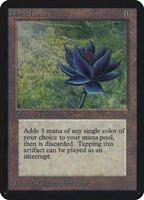
Scrye, the first price guide magazine for collectible card games, launched in June 1994. Its founder had been personally introduced to Magic by Adkison at Gen Con in 1993. InQuest followed in April 1995 from the publishers of Wizard magazine. Together these publications functioned as the Beckett guides of the card boom, printing price tables that transformed teenagers and store owners alike into amateur arbitrageurs. A Black Lotus card listed at a median price of $15 in the first Scrye price guide in June 1994. By Scrye issue nine in 1995, the same card's high price had reached $300: a twenty-times increase in roughly one year.
For context on where those prices have traveled since: a PSA 10 graded example of the Alpha Black Lotus sold at auction in 2021 for $511,050.
The Legends Collation Disaster
The Legends expansion of June 1994 shipped with a factory collation defect. "A" and "B" booster boxes each contained only half of the set's uncommon cards, meaning that collectors who bought one type of box could not complete sets without buying the other. The error forced WotC to create and administer a formal Legends Exchange Program for furious collectors. Street prices on Legends packs ran significantly above MSRP during the shortage period, though specific figures remain anecdotal. The exchange program itself is documented and verified.
WotC Breaks Its Own Market
The speculator economy that Magic had generated was fragile in one specific way: it depended on scarcity. In 1995, WotC released Fourth Edition and Chronicles, both of which reprinted hundreds of cards from earlier sets. A card that had been worth $20 as a Legends rare could become a dollar card overnight once it appeared in Chronicles. Stores and individual speculators who had bought older product as inventory were burned. The backlash was swift and organized. Players and retailers demanded guarantees that their investments in early cards would not be devalued again by future reprints.
On 4 March 1996, WotC responded with the Reserved List: a formal public commitment never to reprint the game's early, high-value cards in standard Magic products. The policy remains binding three decades later and is among the most debated ongoing policies in the game's history. In the span of roughly thirty months, WotC had created a commodity market, crashed that market through overprinting, and then constitutionally guaranteed a floor under a portion of it.
The Affordability Crisis and Its Unintended Consequence
The speculator economy had a direct human casualty that one of Magic's key architects observed firsthand. Skaff Elias, who had been one of the original East Coast playtesters and was by this point working as Magic's brand manager, described watching the consequences outside a game store in 1994: "I can remember going to game stores, probably in '94. Kids couldn't buy the cards. I remember Richard and I coming out of [a shop] after some event and [seeing kids] honestly, like, borderline crying."
Elias identifies that moment as "the genesis of the Pro Tour," a competitive circuit structured around cheaper, more recent cards that gave skilled players a route to prestige and prize money without requiring access to expensive early sets. The speculation frenzy that made early Magic cards unaffordable to the players who loved the game most directly caused the creation of organized professional play.
"Magic turned out to be one of the best economic simulations I had ever seen. The economy was based on cards, and it turned out to be about as predictable as the real thing."
Richard Garfield, "The Creation of Magic: The Gathering," The Duelist, 1993
Act IV: The Hangover, 1994 to 1996
The Trap WotC Built for Itself
Eighteen months of chronic undersupply had produced a retail habit that was perfectly rational at the time and disastrous the moment conditions changed. Every store in the distribution network had learned to order ten times its actual requirement because allocations typically filled only a fraction of orders. When WotC announced for the November 1994 Fallen Empires expansion that it would finally fill every order in full, stores accepted that commitment based on their ordering patterns, not their actual sales velocity.
WotC filled those orders. Approximately 350 to 375 million Fallen Empires cards landed on a market that had expected a tenth of that quantity. Packs fell below MSRP almost immediately. Product that could not move remained on retail shelves until roughly 1998. Stores that had ordered ten cases now had ten cases to pay for when they had only ever expected to receive one.
The Competition Arrives
The industry WotC had invented turned back on it simultaneously. TSR released Spellfire, a derided Dungeons and Dragons knockoff, in 1994. Decipher launched a Star Trek card game the same year. WotC itself released Jyhad, a vampire-themed game that competed for shelf space and buyer attention with its own flagship product. By 1995 the wave broke fully: thirty-eight new collectible card games entered the market in that single year. At Gen Con 1995, retail sell-through across the category was visibly lagging while manufacturers remained euphoric, a textbook description of a bubble at its top.
Homelands, released in October 1995, completed the damage. Overprinted into an already glutted market, it was later characterized by WotC's own head designer as "Magic's all-time design low." Compounding the problem, the rules for the first Pro Tour required players to include five cards from every legal set in their decks, a rule widely interpreted as an attempt to force the unsellable Homelands cards into competitive play. The perception damaged the event's credibility before it had even established itself.
The Geektopia and Its Limits
Inside WotC's Renton offices, boom-era culture had developed along lines that reflected the founders' backgrounds and values. Decision-making was consensus-based. Artists had been paid in stock rather than salaries. Nerf battles took place in the hallways. Offices were furnished from Boeing surplus. The company's openness about personal and social matters extended well past conventional professional boundaries.
The company styled itself a "geektopia," in the words of employee and chronicler John Tynes. The limits of that self-image were tested at a company ski retreat at which a drinking game called "Truth or Swill" resulted in Adkison's candor about his own personal life being condemned by management colleagues as fostering a hostile work environment. His board formally reprimanded him and docked a month's salary. His reported reaction: "This is becoming a company I don't want to be a part of anymore." By 1996, brand consultants had arrived. With them came "brand management" in the conventional corporate sense. Tynes's epitaph for the era: "We did it first. I only wish we'd done it best."
December 1995: The Reset
The business consequences of the market crash arrived in concentrated form in December 1995. Roughly thirty of WotC's approximately 275 employees were laid off in the days immediately before Christmas. The timing had a particular cruelty: staff had been required to pre-purchase tickets for the holiday party before the layoff date was announced. Those who were let go had already paid for an event they would not attend. Survivors privately named it the "1995 Christmas Party of Doom."
The same week, WotC cancelled its entire roleplaying game line. This was the line the company had been founded in 1990 to create. Four months earlier, WotC had launched Everway, an RPG that had generated approximately 17,000 preorders against realistic demand of 5,000 to 10,000, a miniature version of the Fallen Empires problem in another product category. Adkison explained the cancellation with the same bluntness he applied to most things: "We have lost money on every single RPG product." The company that Peter Adkison had started in his basement because he loved roleplaying games now published none. Its founding dream had been cancelled by the very success that paid its bills.
The People Who Lived Through It
Carol Monahan, who joined WotC as Director of Sales in late 1993 at nine dollars an hour, sharing a single desk, phone, and Mac Classic II with two colleagues in the basement rec room of the Renton offices, later described the texture of what hypergrowth and its reversal actually felt like from inside: spiderweb org charts that were redrawn every six months, a company moving into a larger office park on the same week it was conducting its first layoffs. She returned from one business trip to find her new office had been furnished with Boeing surplus equipment while she was away. Her firsthand account of this period is among the most vivid documentation of what the boom and crash felt like at the operational level.
The Pro Tour: Inventing Competitive Play Before the Internet
From Trophy to Salary in Eighteen Months
The first Magic World Championship at Gen Con in August 1994 paid its winner, Zak Dolan of Missouri, a trophy and some out-of-print booster packs. No cash. Skaff Elias, who had watched children standing outside game stores unable to afford cards, proposed building a professional competitive circuit. His model was golf and tennis: Magic as an intellectual sport, with prize money, rankings, and a legitimate professional career available to those skilled enough to sustain one.
The internal skepticism was real and specific. R&D's private terror, according to those involved, was that Magic might prove to be primarily a game of luck rather than skill. If the Pro Tour produced a different Top 8 at every event, each featuring players who had never appeared before, the "intellectual sport" argument would be exposed as marketing. Consistent winners appeared quickly and settled the question in the game's favor.
Pro Tour New York, February 1996
The first Pro Tour ran from 16 to 18 February 1996 in New York. It collided with the third blizzard of that winter. The event's start was delayed to noon. Skaff Elias spent part of the storm on the venue roof, in shorts, repairing blizzard damage with baling wire. Richard Garfield, watching from inside, deadpanned: "Okay, whose bright idea was it to have the first Pro Tour in New York in the middle of winter?"
The 239 players who competed included a Massachusetts social worker named Michael Loconto, who had told Garfield beforehand, in a state of some intoxication, "I'm gonna see you Sunday when I win this thing." He did. Loconto's blue-white control deck carried him through approximately a four-hour final that was cut short for time. Head judge Charlie Catino, who had been one of the original Penn playtesters, computed tiebreakers by hand on notecards. The first prize was $12,000. The junior division paid college scholarships instead of cash, a concession to the concern that prize money might give parents reasons to object to their children competing.
By the end of the 1996 season, individual event prize pools had grown to $132,000. MCI Communications signed a three-year sponsorship of organized play worth $750,000. The documented total prize money for the 1996 Pro Tour season was approximately $477,000. The 1996 World Championship was held inside WotC's own offices. The 1997 World Championship in Seattle became the first Magic event filmed for broadcast on ESPN2, with Sports Illustrated present in the room.
The Characters of the Early Tour
The competitive scene that developed around these events had the cast of a sports drama. Bertrand Lestrée, the French favourite, lost the 1994 World Championship final to Zak Dolan and then the first Pro Tour final to Michael Loconto: the era's closest thing to a tragic bridesmaid. Tom "Tight Tommy" Guevin was Magic's original theatrical competitor, throwing his twenty-sided die to the ceiling before every match and deploying trash talk that once resulted in him being chased from a room with a chair. He lost an approximately five-hour Pro Tour 2 final to Shawn "Hammer" Regnier, an arm-wrestling champion turned professional Magic player. A teenage Jon Finkel drove through the blizzard to the first Pro Tour, encountered a rules controversy that gave him a game loss, and registered in the game's mythology as a foreshadowing of what would become, by common consensus, the greatest competitive career in the game's history.
"I can remember going to game stores, probably in '94, and Magic was too expensive. Kids couldn't buy the cards. I remember Richard and I coming out of [a shop] after some event and [seeing kids] honestly, like, borderline crying. That's the genesis of the Pro Tour."
Skaff Elias, MagicCon Las Vegas panel, May 2026
Act V: The Fall of TSR, 1985 to 1996
The Boardroom Ambush
While Magic: The Gathering was being developed in Garfield's Penn astronomy lounge, another story was unfolding 1,400 miles east in Lake Geneva, Wisconsin. On 22 October 1985, in a ninety-minute board meeting at 201 Sheridan Springs Road, Gary Gygax watched control of TSR, the company he had co-founded and which owned Dungeons and Dragons, pass to Lorraine Williams. Gygax had hired Williams himself, months earlier, to help rescue TSR's troubled finances. He sued, lost, sold his stock, and left. He would never regain a meaningful role in the company that bore his game's name.
The Williams Years
Lorraine Williams was the heiress to the Buck Rogers intellectual property through the Dille family trust. She had a Berkeley history degree and had worked as a hospital administrator before Gygax brought her in. Under her leadership TSR grossed over $40 million a year in its mid-1990s peak. She was the first woman to run a major tabletop games company. She licensed the Buck Rogers property into TSR products, with royalties flowing to the Dille trust in what was well-documented as a fact and interpretively contested as self-dealing. The widespread characterization of Williams as someone who held gamers in contempt traces almost entirely to hostile secondhand accounts from Gygax's circle rather than to anything Williams said directly. She has never given substantive interviews about the period, which makes the record about her feelings toward the hobby extremely difficult to evaluate fairly.
What is not in dispute is the mechanism by which TSR destroyed itself financially, and it had nothing to do with anyone's attitude toward gamers.
The Debt Machine
Ben Riggs's 2022 book Slaying the Dragon documented the mechanism with precision. TSR had a distribution deal with Random House under which the publisher received advance payments on product that was shipped to Random House, not on product that was actually sold by Random House to retailers or consumers. TSR learned to use this arrangement as a credit facility: printing product, shipping it to Random House to trigger the advance payment, and then watching the unsold product sit in Random House's warehouse while the debt accumulated.
The numbers tell the story. By June 1995 TSR owed Random House approximately $11.8 million. Random House then shipped back roughly $14 million worth of returns and sued TSR over a $9.5 million unfulfilled obligation in April 1996. In 1996 alone, TSR published twelve hardcover novels, compared to the traditional one or two, purely to generate advance payments. Trailers full of unsold Dragon Dice accumulated in the warehouse. Total debt reached approximately $30 million.
The Publisher That Could Not Publish
TSR's final indignity was logistical. When the company ran out of operating cash, it stopped paying its printing and logistics firm, a company called J.B. Kenehan. J.B. Kenehan responded by retaining the production plates for the core Dungeons and Dragons rulebooks. The owner of the world's most famous roleplaying game system physically could not print that system. It had become a publisher that could not publish.
Christmas Layoffs: Lake Geneva, December 1996
On the Friday before Christmas 1996, approximately thirty TSR staff members at the Lake Geneva offices were told to wait in their cubicles for a phone call. The specifics that have emerged from participant accounts are grimly precise. David Wise, who had earlier been ordered by management to draft the firing list, was the first person fired. Ed Stark was fired in the morning and rehired that afternoon. That night, at a Christmas party held in deliberate defiance of the day's events, designer Steve Miller backed into a candle and briefly caught fire. Tolkien scholar John Rateliff, surveying the scene, observed that at least he had only been fired rather than set alight. It was, almost to the day, exactly one year after WotC's own pre-Christmas layoffs in Renton.
TSR vs. the Internet
TSR's relationship with its own fan community had been deteriorating throughout the mid-1990s along a separate track. Between 1994 and 1995, TSR dispatched cease-and-desist notices to university FTP sites that were hosting fan-created Dungeons and Dragons material. The move earned the company a Usenet nickname: "T$R, They Sue Regularly." One fan who received such a notice wrote back: "I would rather poke my eye out with a stick before doing anything to help you." That fan, Shannon Appelcline, went on to become one of the RPG industry's foremost historians.
The contrast with WotC's approach to its own online community was stark and was not lost on anyone watching both companies at the time. Community instinct proved to be a survival skill. Ryan Dancey, a Five Rings Publishing executive who drove to Lake Geneva during the winter of 1996 to 1997 to conduct due diligence on a potential acquisition, later wrote the most precise diagnosis of what he found:
"Inside the building, I found a dead company. No customer profiling information. No feedback. No surveys. No 'voice of the customer.' TSR died because it was deaf."
Ryan Dancey, first-person account of his winter 1996-97 due-diligence visit to TSR headquarters
The Acquisition: Buying the Giant, April to June 1997
The Grudge That Required a Middleman
Peter Adkison wanted to buy TSR. Lorraine Williams would not sell to him. Adkison has confirmed this on record: "Lorraine didn't want to sell to me." The reason for this refusal has never been publicly explained by Williams, who stopped giving interviews entirely after 1997.
The solution came through an intermediary. Bob Abramowitz of Five Rings Publishing Group, a company that had licensed the Legend of the Five Rings card game and which had heard rumors of TSR's approaching bankruptcy, negotiated an option to purchase TSR himself. Unable to exercise the option without additional capital, Abramowitz brought it to WotC. WotC bought Five Rings Publishing and exercised the TSR option. The structure of the deal had the effect of inserting a layer of corporate distance between Adkison and Williams, sufficient to allow the transaction to proceed.
WotC announced the combined acquisition on 10 April 1997, one day after TSR's own active lawsuit against WotC, which concerned a 1996 Magic video game, was dismissed by the court. The acquisition closed on 3 June 1997. Bundled into the deal, almost as afterthoughts, were the Legend of the Five Rings card game and Gen Con itself, the gaming convention that Gary Gygax had originally founded in 1968.
The Price
The precise purchase price was never officially disclosed. Two credible figures exist in the historical record: approximately $25 million in direct purchase consideration, per historian Shannon Appelcline, and approximately $30 million all-in including debt assumption, based on Adkison's own recollection that the price was "about how much debt TSR had." WotC also agreed to cover TSR's outstanding unpaid author royalties. The most defensible single characterization, and the one Adkison himself has used, is roughly $25 to $30 million, approximately equal to the size of TSR's accumulated debts.
The Motive
Adkison's stated motivation was simultaneously sentimental and financially rational. "What gamer wouldn't want to be part of the company that bought D&D?" he asked publicly. In the same breath he explained the business case: WotC could make D&D profitable almost immediately simply by reprinting the game's back catalog, which had been sitting inaccessible behind J.B. Kenehan's printer hostage. Dungeons and Dragons was profitable again within approximately three months of the acquisition.
Adkison also did something that was not strictly required by the deal. He wrote personal checks to Gary Gygax, Gygax's ex-wife, and Dave Arneson, D&D's other co-creator, to settle old, disputed royalty claims against TSR. "Perhaps this wasn't strictly necessary," he acknowledged, "but there were many hard feelings." He also mandated, as a permanent condition of WotC's stewardship, that all Dungeons and Dragons products would forever credit Gygax and Arneson as the game's co-creators.
The Move West
Over the summer of 1997, WotC offered jobs to most TSR staff and paid for house-hunting trips and moving costs from Lake Geneva, Wisconsin to Renton, Washington. Many of the employees who had been fired in the December 1996 Christmas layoffs were rehired. The cultural integration was imperfect. At his first all-hands meeting with TSR staff in Lake Geneva, Adkison attempted to lift the room's spirits by leading a humorous song. The reactions were mixed and uncertain. A company of professional game designers that had just spent a year watching its employer die around it was not necessarily ready to be cheered up with a song by its new owner.
Two Codas
Dave Arneson, the co-creator of Dungeons and Dragons who had been relegated to running TSR's shipping department in his later years at the company, wrote to Adkison twice in April 1997, asking to be placed in charge of the newly acquired TSR operation. His letters read: "I would like to run TSR for you. I don't have an ego problem. (Well not a bad one anyway)." He misspelled Adkison's name in two different ways across the two letters. Adkison never called back. The letters survive.
Lorraine Williams walked away from the sale into total, permanent silence. She has not given a substantive interview since 1997. When Ben Riggs approached her while researching Slaying the Dragon, she told him she had "absolutely nothing" to say. Her only known on-camera interview is unreleased footage from a documentary project that had not been made public as of mid-2026.
The Symmetry of the Arc
The dramatic shape of what WotC achieved between May 1990 and June 1997 has a quality that seems engineered but is documented at every point. Peter Adkison founded WotC in 1990 because he loved roleplaying games and wanted to make them. Magic's success in the boom years paid WotC's bills while slowly eliminating every RPG product from the company's catalog. The December 1995 cancellation of the entire RPG line was Magic's success eating its own parent's founding purpose. Then, in 1997, Magic's revenue enabled WotC to buy the one roleplaying game company whose products had made Adkison and his friends want to be in the games business in the first place. The founding dream was cancelled by the very success that then funded its redemption. On his way out of Hasbro in 2002, Adkison personally purchased Gen Con, the convention where both his company and his hobby had found their defining moments. The man who started a games company in a basement ended the decade owning the convention where both his game and his childhood had been born.
The People: A Character Study of the Early WotC Era
Peter Adkison: The Believer
The word most frequently associated with Adkison by those who worked with him in the early years is "shameless," and he uses it about himself. The shamelessness was structural: he could not afford embarrassment if he was going to raise money a few hundred dollars at a time from Boeing co-workers and their acquaintances. He worked 6 a.m. shifts for years to free up afternoons. He ran a company out of a basement while the company he was building to eventually replace that day job was still paying him. His arc from the founding to the TSR acquisition runs from garage idealist through board reprimand through Christmas layoffs to the purchase of the game that had shaped his entire adult sense of possibility. He sold WotC to Hasbro in September 1999 for approximately $325 million. He kept only Gen Con.
Richard Garfield: The Mathematician
Garfield's father worked with architect Louis Kahn. Garfield himself grew up on chess variants and came to D&D through its promise of endless possibilities rather than finite game states. His academic specialty, combinatorics, is precisely the mathematical field most relevant to calculating card interactions across a large set. He invented Magic in the sense that the core concept, the synthesis of trading card collecting with competitive dueling using secret decks, arrived in his mind within days of Adkison's prompt. But two years of rigorous playtesting with named collaborators turned that concept into a product. He left academia for Renton in 1994, filed the trading card game patent in June of that year, and continued designing prolifically even as Magic consumed the industry's attention. His detachment from the speculative economy his game had created was philosophical rather than financial: he held enough equity that Adkison needed his signature to buy TSR.
Lisa Stevens: The Operator
Stevens was WotC's first salaried hire, joining in spring 1991 as the only person in the early company with actual games industry experience, having previously co-founded White Wolf. She masterminded the Gen Con 1993 launch, including the emergency customs negotiation that got the cards to Milwaukee. She founded The Duelist, WotC's in-house magazine. She co-managed the TSR staff relocation in 1997. She stayed through the Hasbro acquisition and left in 2000 to found Paizo, which became the publisher of Pathfinder and continues in that role. Her first-person blog writing about the early WotC years is one of the most reliable documentary sources for the period.
Skaff Elias: The Architect of Professional Play
Elias was one of the original East Coast playtesters, the man who chose the appropriated art for the photocopied playtesting cards. His foot is on the Heal card. As Magic's brand manager he championed professional competitive play against internal skepticism, modeled it consciously on golf and tennis, and spent the eve of the first Pro Tour on a Manhattan venue roof in shorts in a blizzard, repairing structural damage with baling wire. He calls the Pro Tour "the thing I am most proud of." The observation that drove him to create it, watching kids standing outside game stores unable to afford the cards they loved, carries a clarity that few business decisions can claim.
Jesper Myrfors: The Aesthetic Architect
Magic's original art director was a Cornish College art student, described by those who knew him as "burly in a Viking sort of way," who recruited fellow students to illustrate the first print runs. None of them were fantasy art specialists. This was a deliberate choice: Myrfors wanted Magic to look different from every other fantasy game on the market, to have its own visual language rather than the Tolkien-derived aesthetic that dominated the genre. After playing the game once, he told WotC he wanted to be paid in stock rather than a salary. The conviction that investment conveyed is perhaps the most concise summary of what boom-era WotC felt like from inside.
Lorraine Williams: The Antagonist Who Is Not a Cartoon
The historical record on Lorraine Williams is almost entirely constructed from the testimony of people who were hostile to her, and the one narrative about her that has circulated most widely, that she held gamers in contempt and regarded them as socially beneath her, traces to Gary Gygax's circle rather than to anything she said on the record. TSR grossed over $40 million annually under her leadership. She was the first woman to run the industry's largest company. The debt machine that destroyed TSR was real and documented, but it was a structural business mechanism rather than a consequence of her personality. She has declined to offer any public account of herself for nearly thirty years. The responsible approach to her character is to note that the record as it stands is written almost entirely by her adversaries.
Ryan Dancey: The Witness
Dancey was a Five Rings Publishing executive whose due-diligence visit to TSR's Lake Geneva headquarters in the winter of 1996 to 1997 produced one of the most quoted documents of the era's end: his memoir-essay describing a dead company with no customer data, no feedback mechanisms, no surveys, and warehouse lines of inventory priced at zero. He subsequently developed the Open Gaming License in 2000, which opened the D&D rule system to third-party publishers under WotC's ownership, and is widely considered the redemptive epilogue of the TSR story. His account is vivid, first-person, and represents one man's perspective rather than an institutional audit.
The Numbers: A Story in Statistics
The commercial arc of Wizards of the Coast between 1990 and 1999 can be traced in a handful of numbers that are, as the source material puts it, "cinematic on their own."
- $300,000: Total cash ever invested in WotC from founding to acquisition, per Adkison's own account.
- $0.50: Price per share at founding, May 1990.
- $5.00: Price per share when Garfield Games sold its subscription package to fund the Alpha print run, March 1993.
- $1,000+: Approximate value per share by the time of the Hasbro acquisition, September 1999.
- 2.6 million: Cards printed in Limited Edition Alpha, August 1993.
- 10 million: Approximate number of Magic cards sold in roughly six weeks following the Alpha launch.
- ~500 million: Industry estimate for the Revised Edition print run, April 1994, the first large enough to approach satisfying retail demand.
- 2 billion: Magic cards sold by April 1997.
- $2.45: Booster pack MSRP, 1993 to 1995.
- $15: Black Lotus median price, Scrye price guide, June 1994.
- $300: Black Lotus high price, Scrye issue nine, 1995, a twenty-times increase in approximately one year.
- $511,050: Sale price of a PSA 10 signed Alpha Black Lotus at auction, 2021.
- ~$2 million: WotC annual revenue, 1993.
- ~$50 million: WotC annual revenue, 1994.
- ~8: WotC headcount at the August 1993 Gen Con launch.
- ~250: WotC headcount by end of 1995.
- ~500: WotC headcount by 1997.
- 38: New collectible card games launched in 1995 alone, into a market WotC had saturated.
- $12,000: First prize at Pro Tour New York, February 1996.
- $477,000: Documented total prize pool for the 1996 Pro Tour season.
- $750,000: MCI's three-year sponsorship of organized Magic play.
- ~$30 million: TSR's total debt at the time of the 1997 acquisition.
- ~$25 to $30 million: WotC's purchase price for TSR plus its debts, June 1997.
- ~3 months: Time for D&D to return to profitability under WotC ownership.
- $325 million: Hasbro's acquisition price for WotC, September 1999, the epilogue that closes the story.
WotC never published audited financial figures during the period it was privately held, from 1990 to 1999. All revenue numbers above are estimates from triangulated sources including a University of Washington business school case study and the industry publication FundingUniverse, and they should be understood as approximations rather than certified accounts. The card print run figures come from WotC's own announced numbers at the time, cross-referenced against expansion set records compiled by mtg.wiki.
The Early Magic Cards as Historical Artifacts
The cards that came out of the first three Magic print runs, Limited Edition Alpha, Limited Edition Beta, and Unlimited Edition, occupy a unique position in the trading card hobby. They are simultaneously the physical record of a specific moment in game design history, the objects around which the first speculative trading card market organized itself, and collectibles whose value has increased by orders of magnitude over thirty years.
Alpha: August 1993
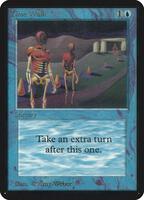
The 2.6 million cards in Limited Edition Alpha were printed by Carta Mundi in Belgium and represent the first commercially available Magic cards in existence. Alpha cards are distinguished from Beta by their rounded corners, a result of slightly different cutting settings at the factory. The set contains 295 cards. The cards that have become the most historically significant are the Power Nine: Black Lotus, Ancestral Recall, Time Walk, Mox Pearl, Mox Sapphire, Mox Jet, Mox Ruby, Mox Emerald, and Timetwister. These cards were considered extremely powerful in the context of the game's original design and were among the first to attract speculative attention once price guides began publishing in mid-1994.
The Black Lotus is the single card most associated with the story of Magic's early economy. It appeared at a median price of $15 in the first Scrye price guide in June 1994. By Scrye issue nine in 1995 it had reached $300. The trajectory from there into the PSA-graded auction market of the 2020s has been documented in real time: a PSA 10 signed Alpha Black Lotus sold for $511,050 at a PWCC auction in January 2021. You can check current Alpha Black Lotus listings on eBay or review recent Alpha Black Lotus sold prices to understand where the market sits today.
Ancestral Recall and the Power Nine
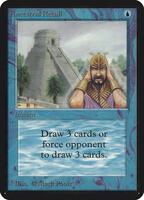
Ancestral Recall, which allows a player to draw three cards for a single blue mana, is generally considered by serious players and historians of the game to be the most powerful card ever printed in Magic's standard game design, more powerful card-for-card than even the Black Lotus. It appeared in Alpha, Beta, and Unlimited only, and was placed on the Reserved List in March 1996 alongside the other Power Nine cards. For those interested in acquiring one, shop Ancestral Recall on eBay or view recent Ancestral Recall sold prices.
The Reserved List and Its Consequences
The March 1996 Reserved List announcement, made in the wake of the Chronicles reprint controversy, permanently altered the economics of early Magic cards. WotC promised that the cards on the list, which includes the Power Nine and most of the high-value cards from Alpha, Beta, Unlimited, Arabian Nights, Antiquities, Legends, The Dark, and Revised, would never be reprinted in standard Magic products. The Reserved List is the structural reason that Alpha and Beta cards have maintained and increased their value over three decades rather than being subject to the kind of reprinting that would dilute scarcity. It remains, as the source material notes, "bitterly debated" thirty years after its announcement.
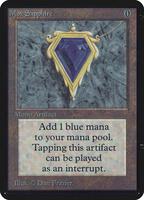
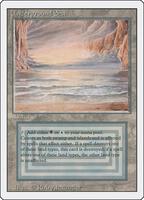
For those researching the Mox cycle, shop Alpha Mox Sapphire on eBay or check recent Mox Sapphire sold prices. For the original dual lands from Revised Edition, shop Revised Underground Sea on eBay or see recent Underground Sea sold prices. You can also browse the full range of early Magic singles on TCGPlayer.
Epilogue: From $300,000 to $325 Million
In September 1999, Hasbro acquired Wizards of the Coast for approximately $325 million. The company that had been founded nine years earlier with $300,000 in total raised capital, much of it in checks of a few hundred dollars from friends and Boeing night-shift workers, had grown into one of the most valuable game companies on earth.
The fifty-cent shares from the May 1990 founding and the five-dollar shares from the March 1993 Garfield Games subscription had turned into life-changing wealth for the people who had written those small checks. The Boeing janitor who pressed her $1,400 life savings on a guilty Adkison during those late-night work sessions, over his protests, had invested in something that returned several hundred times her stake.
The story between those two dates, the founding in the Kent basement and the Hasbro sale, contains everything that makes it worth telling as a piece of history: a founding idea that was almost immediately threatened by a federal lawsuit; a mathematician's synthesis that invented a new form of entertainment; a speculative boom that turned cardboard into currency and then broke its own market; the gut-punch of watching the founding purpose of the company be cancelled by the revenue stream that paid for everything; and then, as if the story had been written to require one more move, the basement company buying the industry giant it had grown up worshipping, and the man who started it ending the decade owning the convention that had been the first room where he felt his hobby taken seriously.
ESPN2 filmed the 1997 Magic World Championship. Sports Illustrated was in the room. The Pokémon Trading Card Game license came to WotC in 1998 and 1999. Hasbro arrived that fall with a check. The story of the years that built all of that, the seven years from the Kent basement to the Lake Geneva closing, is the part that has not yet been fully told in the medium it deserves.
Every number in it is documented. Every character is alive. The cards still exist, and the most famous of them is worth half a million dollars.
Frequently Asked Questions
When was Wizards of the Coast founded and who founded it?
How did Richard Garfield come to design Magic: The Gathering?
How much did Wizards of the Coast raise before Magic: The Gathering launched?
What happened at Gen Con 1993 when Magic: The Gathering launched?
How fast did Magic: The Gathering sell in its first weeks?
Why is the Alpha Black Lotus so valuable?
What was the Reserved List and why was it created?
How did WotC acquire TSR and Dungeons and Dragons?
Why did TSR go bankrupt in the 1990s?
What was the Fallen Empires overprint and why did it matter?
What was the first Magic Pro Tour and who won it?
How much did Hasbro pay to acquire Wizards of the Coast?
Cards Featured in This Article
Sealed Products Featured in This Article
Magic: The Gathering Alpha Booster Pack
The original 1993 booster pack sold at $2.45 MSRP, containing 15 cards from the first 2.6-million-card print run, including some of the most valuable cards ever produced.
🛒 Shop on eBay 📊 eBay Sold PricesMagic: The Gathering Beta Booster Box
The Beta Edition booster box from late 1993, one of the earliest sealed Magic products still occasionally appearing at auction, representing the second of the three original Limited Edition print runs.
🛒 Shop on eBay 📊 eBay Sold Prices